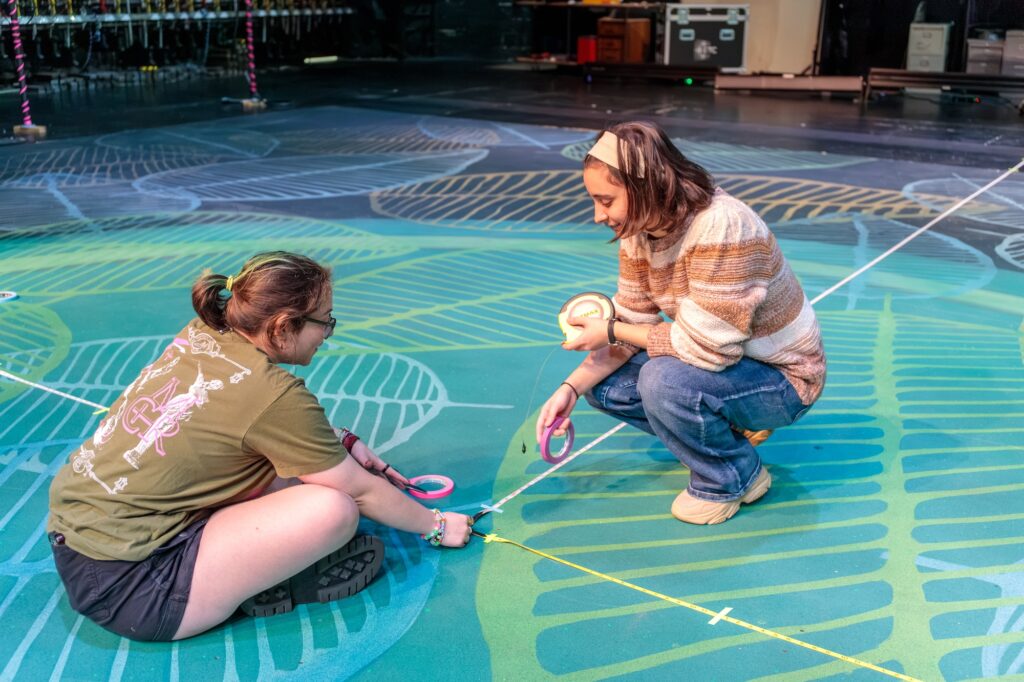
What does it take to transform a scenic designer’s drawing into a rehearsal space?
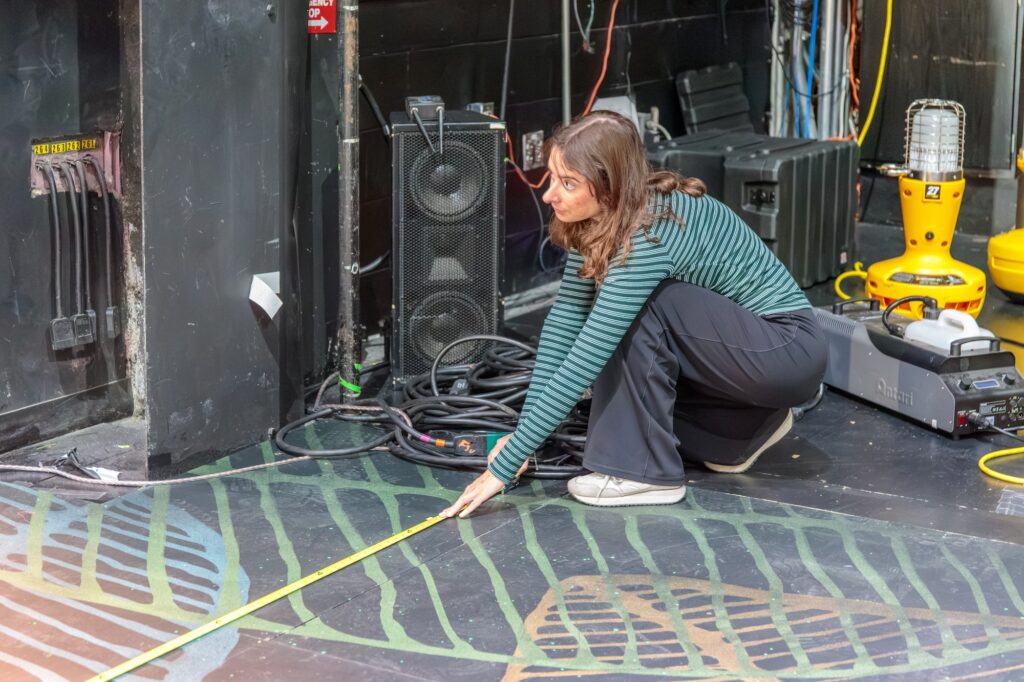
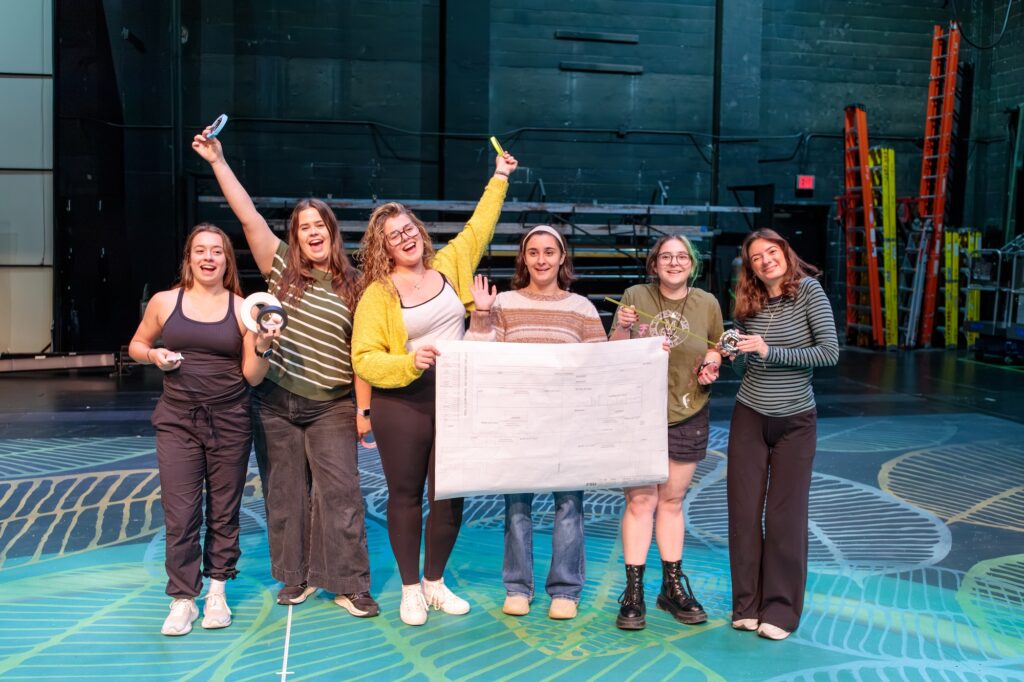
For students in Stage Management I at Florida State University, the answer recently involved architectural drawings, scale rulers, tape measures, colored tape, and plenty of teamwork. The class, which includes sophomore BFA Stage Management students as well as BA students interested in stage management, spent two class sessions learning a professional skill known as tapeout: translating a scenic designer’s scaled ground plan into a full-size representation of the set on the rehearsal room floor. It is a process that happens behind the scenes long before an audience arrives, and an example of how FSU stage management students learn about the profession by doing it.
From Paper to Full Scale
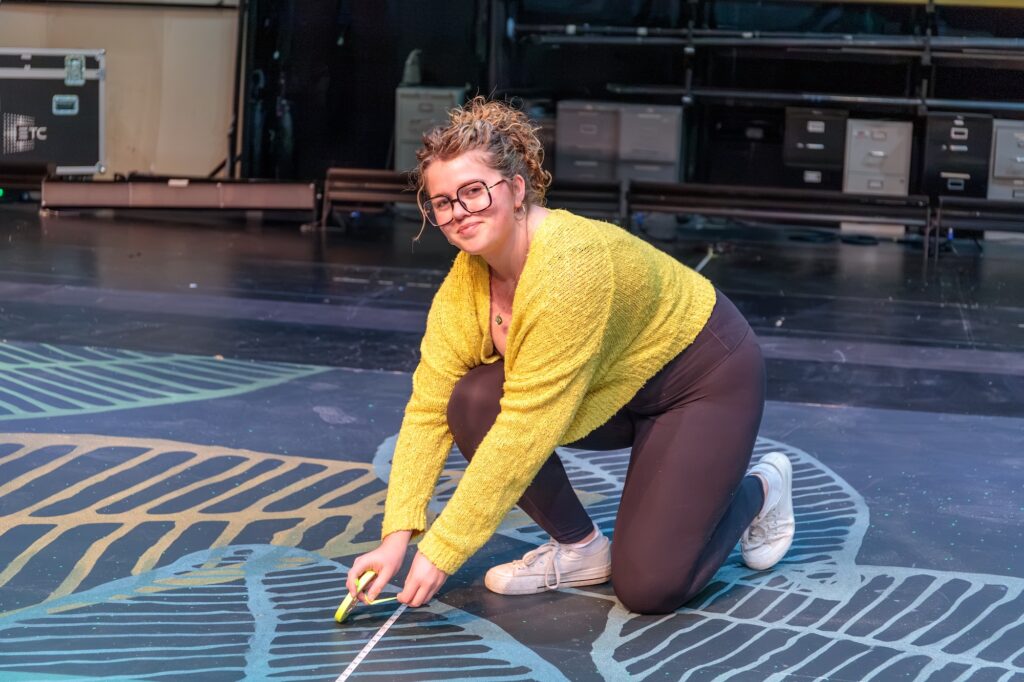
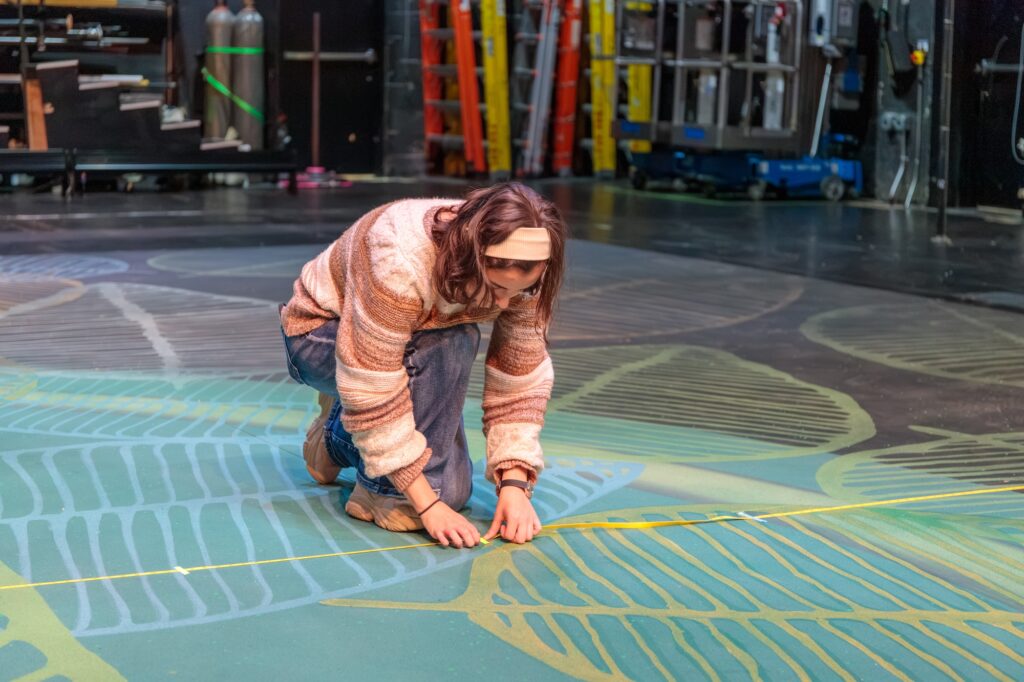
When a theatrical production begins rehearsals, the actual set often doesn’t exist yet. Actors and directors, however, still need to understand the physical environment where production will eventually take place. Working from a scaled, bird-eye-view drawing created by the scenic designer, stage managers calculate the dimensions of walls, platforms, staircases, walkways and other scenic elements. They then recreate those boundaries on the rehearsal floor using colored tape.
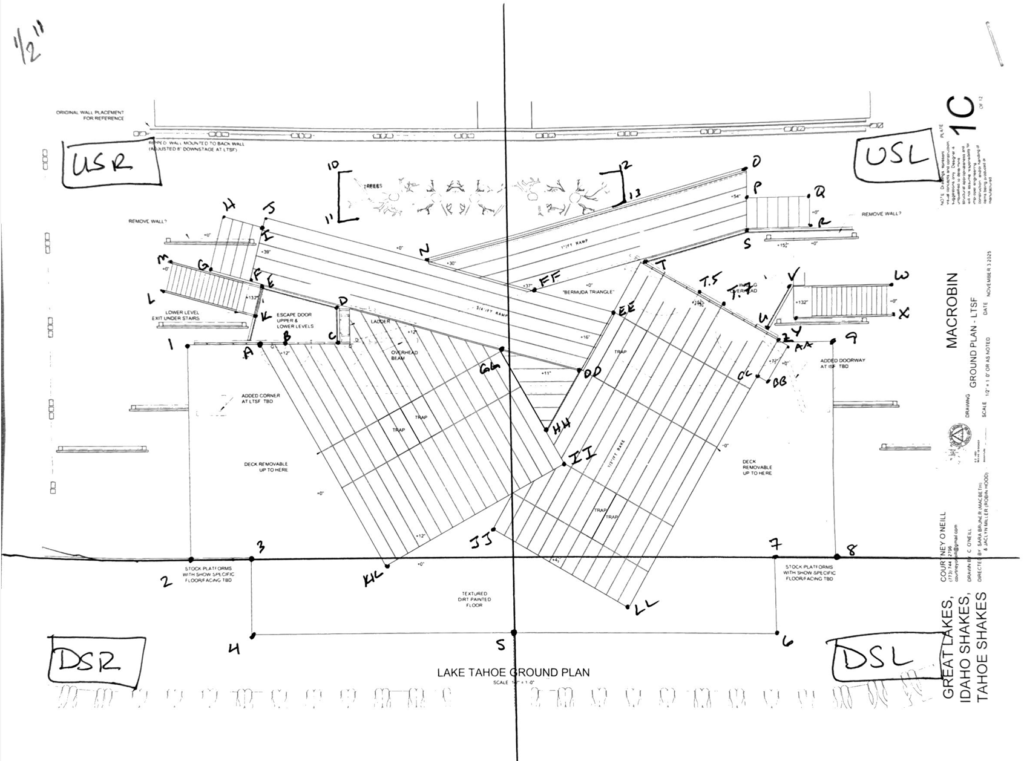
For this group of 12 students, that meant first learning how to use an architectural scale ruler and interpret a scenic ground plan before transferring their measurements into the physical space. At first, the collection of individual points didn’t make much sense.
“I remember looking down at all the plots we set and just thinking to myself, ‘I have no idea what I am looking at here,” said Stage Management student Chase Martin.
Then the class started connecting the dots.
“Once the whole class started working together, identifying which points needed to be connected and literally connecting the dots, things started to really come together in my mind,” Martin said.
Casey Sammarco, Program Director of the BFA in Stage Management, describes that transformation, watching the full-scale set emerge from the points students have plotted, as one of the exercise’s biggest “aha” moments.
Learning by Getting It Wrong
Not everything worked perfectly the first time, and that was part of the lesson. As students worked, there were moments when they realized something they had plotted simply didn’t look right. The class had to stop, identify the problem, re-measure and correct its work. For Martin, having the opportunity to make and solve those mistakes in the classroom was especially valuable.
“It’s really helpful to get to have the opportunity to see how things can go wrong in the process and solve them in a safe space where the stakes are so much lower than on a real production,” he said.
The exercise requires technical precision and spatial reasoning, but it also asks students to communicate, collaborate, assess their own work and solve problems together. Those are difficult skills to develop through reading alone.
“The thing about stage management is that there is only so much you can learn from reading and private study,” Martin said. “The only way to truly learn how to be a stage manager is to do it.”
From the Classroom to the Production
For Martin, that connection between class and production is already happening. He recently served as Production Assistant for FSU’s production of Bring It On, where he had already participated in a tapeout. Returning to the process in Stage Management I gave him an opportunity to reflect on that experience and think about how the team could work more efficiently the next time.
Other FSU stage management students are taking the same skills even further. Sammarco recently saw students sharing their own tapeout experiences from professional work, one on the national tour of Death Becomes Her and another at The Muny in St. Louis.
That progression, from learning a skill in class, to practicing it on an FSU production, to eventually using it in professional theatre, is built into the student experience. Sammarco describes stage management as the “air traffic control” of a theatrical production. Stage managers connect actors, directors, designers, technicians and production teams, helping information move among the many people responsible for bringing a performance to life.
Learning to do that requires more than knowing what a stage manager should do. Students need opportunities to actually do the work.
“You will be making the very same paperwork that you’ll use in a real production, you’ll be actively collaborating with other students and stage managers, and eventually, you’ll be on actual stage management teams doing the job itself,” Martin said.
For him, that balance of real-world experience and support is what makes the program distinctive.
“We are constantly being prepared for the real world by being put in situations where we are doing the job, but always have access to assistance, guidance, and mentorship.”
Sometimes that preparation starts with an empty rehearsal room, a ground plan and a roll of tape.